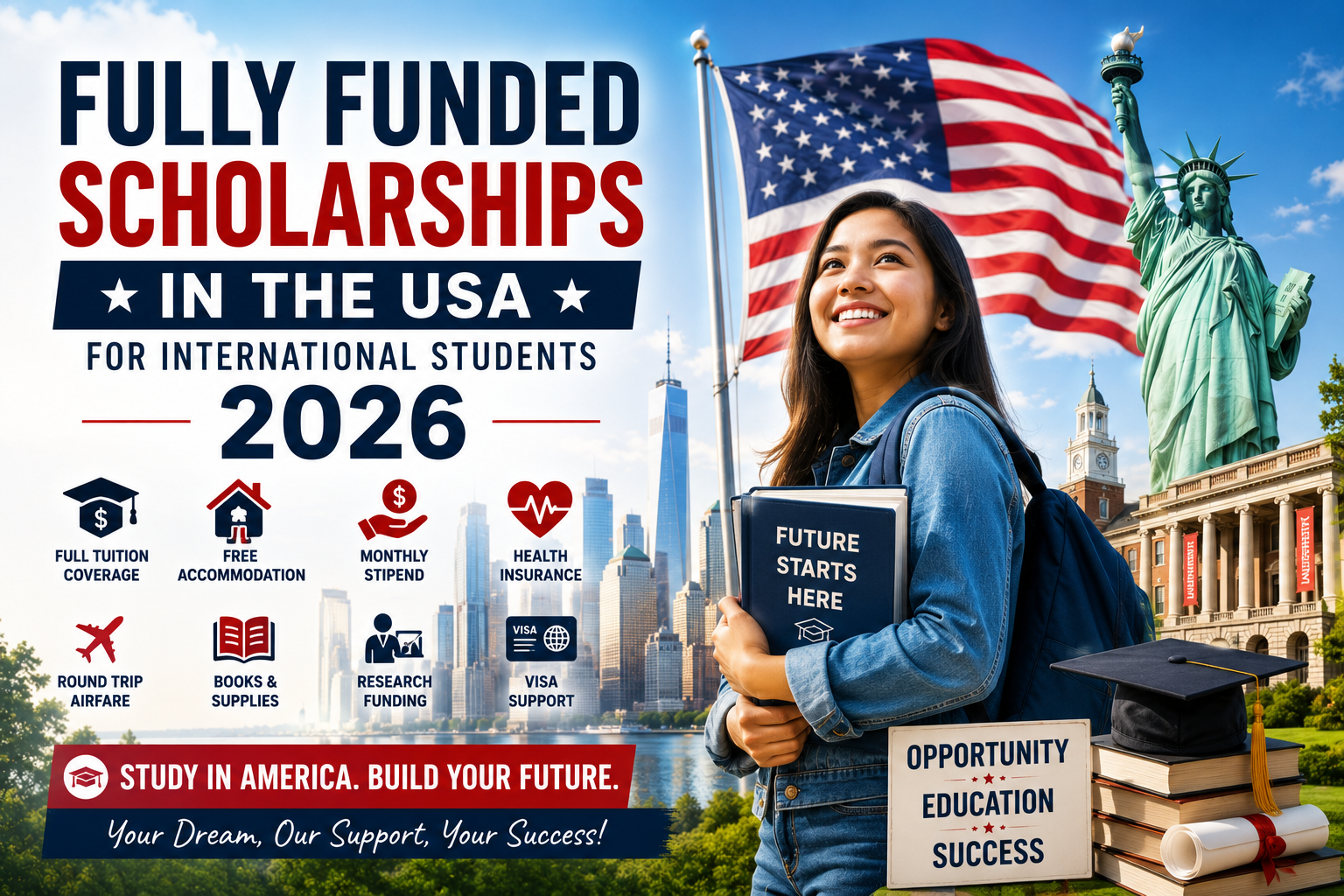
Studying in the United States is a dream shared by millions of students around the world. Home to many of the world’s highest-ranked universities, cutting-edge research institutions, and internationally recognised qualifications, the USA continues to attract talented students seeking a world-class education and better career opportunities.
One of the biggest concerns for international students, however, is the cost. Tuition fees, accommodation, health insurance, books, and daily living expenses can make studying in America seem financially out of reach.
The good news is that hundreds of fully funded scholarships are available each year for international students. These scholarships are designed to support outstanding students by covering most—or even all—of the costs associated with studying in the United States.
Depending on the scholarship, benefits may include:
- Full tuition fees
- Monthly living allowance
- Free accommodation
- Health insurance
- Airfare
- Research funding
- Books and study materials
- Internship opportunities
Whether you’re planning to pursue an undergraduate degree, master’s degree, PhD, or research programme, there are scholarships available to help make your dream of studying in the USA a reality.
This guide explores some of the best fully funded scholarships available in 2026, eligibility requirements, application tips, and how to maximise your chances of success.
Why Study in the USA?
The United States remains one of the world’s most popular study destinations for several reasons.
Students benefit from:
- Globally recognised degrees
- World-class universities
- Outstanding research facilities
- Diverse academic programmes
- Modern campuses
- Career development opportunities
- International networking
- Access to global employers
Graduating from a reputable American university can significantly improve your career prospects both locally and internationally.
What Is a Fully Funded Scholarship?
A fully funded scholarship covers nearly all of the expenses associated with studying overseas.
Depending on the programme, it may include:
- 100% tuition fees
- Accommodation
- Monthly stipend
- Health insurance
- Round-trip airfare
- Visa support
- Books and supplies
- Research funding
- Conference travel
- Living expenses
Some scholarships even provide additional funding for dependents or professional development opportunities.
Best Fully Funded Scholarships in the USA
Several prestigious scholarship programmes are available to international students each year.
| Scholarship | Study Level | Funding |
|---|---|---|
| Fulbright Foreign Student Program | Master’s & PhD | Fully Funded |
| Knight-Hennessy Scholars | Graduate | Fully Funded |
| Yale University Scholarships | Undergraduate, Master’s & PhD | Fully Funded (selected programmes) |
| Stanford Graduate Fellowship Opportunities | Graduate | Fully Funded (eligible programmes) |
| AAUW International Fellowships | Master’s & PhD | Fully Funded (selected recipients) |
| Joint Japan/World Bank Scholarship | Master’s | Fully Funded |
| Rotary Peace Fellowship | Master’s | Fully Funded |
| Hubert H. Humphrey Fellowship | Professional Development | Fully Funded |
| University Merit Scholarships | Undergraduate & Graduate | Full Tuition (selected awards) |
| Government and Foundation Scholarships | Various | Fully Funded |
Each scholarship has its own eligibility criteria, application process, and deadlines.
Fulbright Foreign Student Program
The Fulbright Program is one of the world’s most prestigious international scholarship programmes.
It supports talented students pursuing:
- Master’s degrees
- PhD programmes
- Research opportunities
The scholarship typically covers:
- Tuition
- Monthly stipend
- Airfare
- Health insurance
- Books
- Visa support
Students from more than 150 countries are eligible to apply, subject to country-specific requirements.
Knight-Hennessy Scholars
Offered through Stanford University, the Knight-Hennessy Scholars programme supports exceptional graduate students from around the world.
Benefits include:
- Full tuition
- Living allowance
- Academic enrichment
- Leadership development
- Travel funding
The programme seeks students with strong leadership potential and outstanding academic achievement.
Yale University Scholarships
Yale University offers generous financial aid packages for eligible international students.
Funding may include:
- Full tuition
- Accommodation assistance
- Living expenses
- Research support
Awards vary depending on financial need and academic merit.
Stanford Graduate Funding
Stanford University offers several funding opportunities for graduate students across multiple disciplines.
Eligible students may receive:
- Full tuition
- Research funding
- Teaching assistantships
- Monthly stipend
Funding availability varies by faculty and programme.
AAUW International Fellowships
The American Association of University Women (AAUW) supports women pursuing graduate and postgraduate studies in the United States.
Funding can assist with:
- Tuition
- Living expenses
- Educational costs
- Research
Applicants must demonstrate strong academic achievement and leadership potential.
Joint Japan/World Bank Scholarship
This programme supports students from developing countries pursuing postgraduate education in development-related fields.
Benefits commonly include:
- Tuition
- Monthly living allowance
- Airfare
- Health insurance
Graduates are expected to contribute to the development of their home countries after completing their studies.
Rotary Peace Fellowship
Rotary International offers fully funded fellowships for students pursuing peace and conflict resolution studies.
The scholarship covers:
- Tuition
- Accommodation
- Living expenses
- Internship opportunities
- Travel
It is highly competitive and attracts applicants from around the world.
Hubert H. Humphrey Fellowship
Designed for experienced professionals rather than degree-seeking students, this fellowship provides advanced professional development in the United States.
Benefits include:
- Tuition
- Living allowance
- Airfare
- Professional training
- Networking opportunities
It is particularly suitable for mid-career professionals seeking leadership development.
Universities Offering Full Scholarships
Many American universities provide generous funding to outstanding international students.
These include institutions such as:
- Harvard University
- Yale University
- Princeton University
- Stanford University
- Duke University
- University of Chicago
- Columbia University
- Cornell University
- Rice University
- Vanderbilt University
Scholarship availability varies by programme, faculty, and financial need.
Who Can Apply?
Eligibility requirements differ between scholarship programmes, but applicants are generally expected to demonstrate:
- Strong academic performance
- Leadership potential
- Community involvement
- English language proficiency (where required)
- Admission to an eligible programme
- Motivation to contribute to their field after graduation
Some scholarships are open to all nationalities, while others are restricted to applicants from specific countries or regions.
How to Apply for Fully Funded Scholarships in the USA
Winning a fully funded scholarship requires careful planning and a strong application. While these scholarships are highly competitive, thousands of international students receive funding every year because they prepare thoroughly and submit high-quality applications.
Understanding the application process can significantly improve your chances of success.
Step 1: Choose the Right Scholarship
Not every scholarship is suitable for every applicant.
Some scholarships are available only for:
- Undergraduate students
- Master’s students
- PhD candidates
- Researchers
- Working professionals
- Students from specific countries
Before applying, carefully review:
- Eligibility requirements
- Degree level
- Field of study
- Application deadlines
- Required documents
Applying only for scholarships you genuinely qualify for saves time and increases your chances of success.
Step 2: Research Universities
Many American universities offer their own scholarships in addition to government and private funding opportunities.
When researching universities, consider:
- Tuition costs
- Scholarship availability
- Course rankings
- Graduate employment outcomes
- Research opportunities
- Campus facilities
- International student support
Choosing universities that provide generous financial aid can greatly reduce your overall study costs.
Step 3: Meet the Admission Requirements
In most cases, you must first meet the university’s admission requirements before being considered for a scholarship.
Common requirements include:
- Academic transcripts
- Proof of previous qualifications
- English language proficiency
- Personal statement
- Recommendation letters
- Resume or CV
- Portfolio (for creative programmes)
Some universities automatically consider eligible applicants for scholarships, while others require a separate scholarship application.
Step 4: Prepare a Strong Personal Statement
Your personal statement is one of the most important parts of your application.
It should clearly explain:
- Why you chose your course
- Your academic achievements
- Career goals
- Leadership experience
- Community involvement
- Why you deserve financial support
Avoid generic statements.
Instead, use real examples that demonstrate your motivation, resilience, and commitment to your chosen field.
Step 5: Obtain Strong Recommendation Letters
Most scholarship programmes require two or three recommendation letters.
Good referees may include:
- University lecturers
- Professors
- School principals
- Employers
- Research supervisors
Strong recommendation letters should highlight:
- Academic ability
- Leadership
- Work ethic
- Character
- Potential for future success
Ask your referees well before the application deadline to give them enough time to prepare thoughtful letters.
Step 6: Demonstrate Academic Excellence
Fully funded scholarships are highly competitive.
Successful applicants often have:
- Strong grades
- High GPA
- Academic awards
- Research experience
- Publications
- Leadership positions
- Volunteer work
Even if your grades are not perfect, demonstrating consistent improvement and meaningful achievements can strengthen your application.
Documents You May Need
Although requirements vary, most scholarship applications request:
- Passport
- Academic transcripts
- Degree certificates
- Personal statement
- Resume or CV
- Recommendation letters
- English language test results (if required)
- Research proposal (for some postgraduate programmes)
- Portfolio (where applicable)
Having digital copies ready before applications open can help you avoid last-minute delays.
Do You Need IELTS or TOEFL?
Many universities require proof of English language proficiency.
Accepted tests commonly include:
- IELTS Academic
- TOEFL iBT
- PTE Academic
- Duolingo English Test (accepted by some universities)
However, some universities waive English language requirements if:
- Your previous education was completed in English.
- You are from an English-speaking country.
- Your institution provides proof of English as the language of instruction.
Always check the specific requirements for both the university and the scholarship programme.
Common Mistakes Applicants Make
Many students lose scholarship opportunities because of avoidable errors.
Common mistakes include:
- Missing application deadlines.
- Submitting incomplete applications.
- Writing generic personal statements.
- Ignoring eligibility requirements.
- Weak recommendation letters.
- Poorly prepared resumes.
- Applying for too few scholarships.
- Failing to proofread applications.
Taking extra time to prepare each application can significantly improve your chances of success.
Tips to Increase Your Chances of Winning
Competition is strong, but there are proven strategies that successful applicants often follow.
Focus on:
- Applying to multiple scholarships.
- Maintaining strong academic results.
- Developing leadership experience.
- Participating in community service.
- Tailoring every application.
- Starting early.
- Carefully following all instructions.
- Proofreading every document before submission.
Scholarship committees are looking for students who not only perform well academically but also demonstrate leadership, initiative, and the potential to make a positive impact in their communities and professions.
How Competitive Are Fully Funded Scholarships?
Prestigious scholarships receive applications from thousands of talented students each year.
Selection committees typically evaluate:
| Selection Criteria | Importance |
|---|---|
| Academic Performance | Very High |
| Leadership Experience | High |
| Personal Statement | Very High |
| Recommendation Letters | High |
| Community Involvement | High |
| Research Potential | High (Postgraduate) |
| Communication Skills | Moderate to High |
While competition is intense, many students are successful because they present a well-rounded application rather than relying solely on grades.
Can You Work While Studying?
Many international students are permitted to work part-time while studying in the United States, subject to the conditions of their student visa and university policies.
Working part-time can help you:
- Gain valuable work experience.
- Build professional networks.
- Develop new skills.
- Supplement your living expenses.
However, if you receive a fully funded scholarship that covers tuition, accommodation, and living costs, working may be optional rather than financially necessary.
Frequently Asked Questions
Can international students get fully funded scholarships in the USA?
Yes.
Many American universities, government programmes, and private organisations offer fully funded scholarships specifically for international students.
Depending on the scholarship, funding may cover:
- Full tuition fees
- Accommodation
- Monthly living allowance
- Health insurance
- Airfare
- Books and study materials
- Research funding
Eligibility requirements vary, so always review the scholarship guidelines carefully before applying.
Do I need perfect grades to win a scholarship?
Not necessarily.
While strong academic performance is important, scholarship committees also consider:
- Leadership experience
- Community service
- Research achievements
- Work experience
- Personal statement
- Recommendation letters
A well-rounded application often performs better than grades alone.
Can undergraduate students apply?
Yes.
Many universities offer fully funded scholarships for undergraduate students, although opportunities are generally more competitive than postgraduate funding.
There are also scholarships specifically designed for master’s, PhD, and professional programmes.
Do scholarships cover living expenses?
Many fully funded scholarships provide a monthly stipend to help cover:
- Accommodation
- Food
- Transportation
- Study materials
- Personal expenses
The amount varies depending on the scholarship and the university.
Do I need IELTS?
Some universities require proof of English language proficiency through exams such as IELTS or TOEFL.
However, certain universities waive this requirement if:
- Your previous education was taught in English.
- You meet alternative language requirements.
- The scholarship programme offers an exemption.
Always confirm the requirements before applying.
Can my family come with me?
Some student visa categories allow eligible dependents to accompany international students.
However, financial support for spouses and children varies depending on the scholarship programme and immigration rules.
Always review the visa conditions before making relocation plans.
Common Reasons Scholarship Applications Are Rejected
Many strong applicants miss out because of avoidable mistakes.
Some of the most common reasons include:
- Missing the application deadline.
- Submitting incomplete documents.
- Ignoring eligibility requirements.
- Weak personal statements.
- Poor recommendation letters.
- Low academic performance.
- Failing to follow application instructions.
- Copying generic scholarship essays.
Paying close attention to the application guidelines can significantly improve your chances of success.
Tips for Writing a Winning Scholarship Essay
Your scholarship essay gives the selection committee an opportunity to understand who you are beyond your academic results.
A strong essay should:
- Tell your personal story.
- Explain your career goals.
- Demonstrate leadership.
- Highlight challenges you’ve overcome.
- Show how the scholarship will help you achieve your ambitions.
- Explain how you intend to contribute to your community or profession after graduation.
Be authentic. Scholarship committees read thousands of applications, and genuine, well-structured stories often leave a stronger impression than overly formal or exaggerated writing.
Best Fields of Study for Scholarship Opportunities
Although scholarships exist across almost every discipline, some fields receive particularly strong funding due to global demand for skilled professionals.
These include:
- Engineering
- Computer Science
- Artificial Intelligence
- Data Science
- Medicine
- Nursing
- Public Health
- Environmental Science
- Business Administration
- Economics
- Agriculture
- Education
Students pursuing research in these areas may also have access to additional grants and funding opportunities.
What Happens After You Receive a Scholarship?
Receiving a scholarship is only the beginning of your journey.
After acceptance, you’ll typically need to:
- Accept the scholarship offer.
- Complete university enrolment.
- Apply for your student visa.
- Arrange accommodation.
- Purchase health insurance (if not included).
- Book your flights.
- Attend university orientation.
- Register for classes.
Many universities also provide dedicated support services to help international students settle into campus life.
Life as an International Student in the USA
Studying in the United States offers much more than academic qualifications.
International students gain opportunities to:
- Learn from globally recognised professors.
- Access world-class research facilities.
- Build international friendships.
- Join student organisations.
- Develop leadership skills.
- Participate in internships.
- Build professional networks.
- Experience American culture.
These experiences can enhance both your personal development and future career prospects.
Final Thoughts
The United States remains one of the world’s leading destinations for international education, offering outstanding universities, innovative research opportunities, and qualifications recognised by employers around the globe. Although studying in America can be expensive, fully funded scholarships make it possible for talented students from all backgrounds to pursue their academic goals without the burden of significant financial costs.
Whether you’re planning to study at the undergraduate, master’s, or PhD level, there are numerous scholarship opportunities that can cover tuition, accommodation, living expenses, health insurance, and even travel costs. The key is to start your research early, identify scholarships that match your qualifications, and prepare a high-quality application that highlights your academic achievements, leadership experience, and long-term goals.
Competition is strong, but every year thousands of international students successfully earn scholarships because they invest time in preparing compelling applications and meeting all eligibility requirements.
With determination, careful planning, and persistence, a fully funded scholarship can become your pathway to studying at a prestigious American university, gaining internationally recognised qualifications, expanding your global network, and building a successful future both during and after your education.